Category: Study & Career Growth

  • PMP Certification in Nigeria: The Complete 2026 Guide

    PMP Certification in Nigeria: The Complete 2026 Guide

    Project management is one of the few career paths in Nigeria where a single certification can genuinely shift your salary bracket, your job title, and the kind of roles you get shortlisted for. 

    The Project Management Professional (PMP) credential is the one people ask about most and also the one they’re most likely to have heard conflicting things about. This guide breaks down what it actually costs, who it’s for, and when your money is better spent elsewhere.

    What is a PMP Certification?

    The PMP is a globally recognized credential issued by the Project Management Institute (PMI), the same body behind the PMBOK Guide. It certifies that you can lead and direct projects across industries , not just follow a template, but actually manage scope, budget, risk, stakeholders, and teams from initiation to close. It’s vendor-neutral, which means it isn’t tied to one software tool or one industry; a PMP holder can move between construction, oil and gas, telecoms, fintech, and NGOs without re-certifying. That portability is a big part of its appeal in Nigeria, where professionals often build careers across very different sectors.

    How much does PMP cost in Nigeria?

    The PMP exam costs $555, that’s for non members. For members it costs $405 but the cost of the exam can also vary depending on the specific partner you’re taking the course with. 

    PMI membership itself costs roughly $129 plus a one-time $10 application fee annually, and it’s usually worth paying. It unlocks the discounted exam fee plus a free digital copy of the PMBOK Guide, which is one of your core study resources. 

    Then there’s local training. PMI requires 35 hours of project management education before you’re even eligible to sit the exam, and local training providers in Lagos and Abuja typically charge between ₦150,000 and ₦250,000 for this, covering the contact hours, mock exams, and application support. 

    If you don’t pass on the first attempt, retake fees add another $275 for members and $375 for non-members (some providers quote higher figures, so treat this as a floor, not a ceiling). 

    Add it up, and a realistic all-in budget for a Nigerian candidate, membership, training, exam fee, materials, lands somewhere between ₦600,000 and ₦1,000,000+, depending on the exchange rate at the time and how much local training you need.

    Who should get PMP?

    PMP makes the most sense for people who are already doing project management work, even informally, and need the paper to prove it. That includes:

    • Mid-career professionals in construction, oil and gas, telecoms, or fintech who lead teams or coordinate deliverables but don’t have a formal credential
    • People targeting roles at multinationals or NGOs where PMP is explicitly listed as a requirement or strong preference
    • Professionals eyeing remote or international project management roles, where PMP is one of the few Nigerian-earned credentials that reads the same everywhere
    • Anyone who already meets PMI’s eligibility bar (either a bachelor’s degree with 3 years/4,500 hours leading projects, or a diploma with 5 years/7,500 hours) and won’t be starting from zero

    If you don’t yet have real project-leading experience, PMP isn’t accessible to you yet anyway, PMI’s eligibility rules require it before you can even sit the exam.

    Benefits of PMP Certification

    • Global recognition — it travels with you across industries and borders in a way most local certifications don’t
    • Salary uplift — certified project managers in Lagos report significantly higher pay than their uncertified peers, with PMPs in sectors like telecom, oil and gas, and fintech earning between ₦600,000 and ₦1.8 million monthly in 2026 
    • Structured skill validation — it forces you to formalise skills (risk management, stakeholder communication, budgeting) that many Nigerian PMs pick up ad hoc on the job
    • Credibility with clients and employers — especially useful for consultants and freelancers who need to prove competence to people who’ve never worked with them before
    • Access to a global PMI community — chapters, webinars, and templates that keep you current after certification

    Common misconceptions about PMP

    Common misconception about PMP cost in Nigeria

    “PMP will get me a job even with no experience.” It won’t, you can’t sit the exam without meeting the experience threshold in the first place, and even once certified, employers still want to see applied experience.

    “It’s just about memorising PMBOK.” The exam has shifted heavily toward scenario-based questions testing judgment across predictive, agile, and hybrid approaches, it’s less about reciting processes and more about how you’d actually handle a live project problem.

    “Once I pass, I’m done.” PMP isn’t a one-time credential, you need 60 Professional Development Units every three years to keep it active, which is an ongoing time and sometimes financial commitment.

    “PMP guarantees a raise.” It improves your odds and your negotiating position, but it doesn’t automatically trigger a promotion, how you use it in interviews and performance conversations still matters.

    When PMP is NOT worth it

    • You’re early career and don’t yet meet PMI’s experience requirements, you’d be spending money on training you can’t yet convert into a sitting
    • Your industry or target employer doesn’t ask for it and instead values something more specific, say, PRINCE2 for UK-facing roles, or an Agile/Scrum credential for product teams
    • You’re doing project coordination in a very small or informal setting where the credential wouldn’t change your ceiling
    • Cash flow is genuinely tight and the ₦600,000–₦1,000,000+ investment would displace more urgent priorities,  in that case, cheaper, faster credentials can build momentum first
    • You’re chasing PMP because it’s trending rather than because it maps to a role or salary jump you can actually see ahead of you

    Alternatives to PMP

    • CAPM (Certified Associate in Project Management) — PMI’s entry-level credential, no experience requirement, a good stepping stone toward PMP later
    • PRINCE2 — more common in UK-linked and government-adjacent roles; process-driven rather than judgment-based
    • Certified ScrumMaster (CSM) / PSM — better fit if you’re working in tech or product teams running agile sprints rather than large predictive projects
    • Google Project Management Certificate — cheaper, faster, and a reasonable entry point if you’re testing whether project management is the right path before committing to PMP-level spend

    Our Verdict

    PMP is worth it if you already have real project-leading experience, you’re in or targeting an industry that rewards it, and you can commit to the study time and the full cost,  not just the exam fee, but training and membership too. It’s a strong, portable credential that can meaningfully move your salary and your options. It’s not worth it as a first step into project management, and it’s not a substitute for experience. Treat it as the credential that formalises work you’re already doing, not the thing that starts your project management career for you.

    Watch the full conversation on The Ed Chronicles

    If you want the fuller picture behind this article, Episode 1 of The Ed Chronicles Show digs into exactly this debate, what a credential like PMP is really worth in the Nigerian job market and how to think about it as an investment, not just a line on your CV. It’s a good companion watch before you commit any money to training or exam fees.

    📺 Watch on YouTube

    Thinking about financing your certification?

    PMP is a real investment, and cost is often the biggest thing standing between Nigerian professionals and the credential. Edubanc’s Exam Financing lets you spread the cost of certifications like PMP so you can start now and pay over time, instead of waiting until you’ve saved the full amount upfront. 

  • Best CFA & Financial Certification Training Centres in Nigeria (2026). Which One Is Worth Your Money?

    Best CFA & Financial Certification Training Centres in Nigeria (2026). Which One Is Worth Your Money?

    If you’re thinking about earning your CFA, FMVA, ACCA, ICAN, or another professional finance certification, one of the first questions you’ll probably find yourself asking is: “Where can I get quality training in Nigeria?”

    While many candidates choose online learning platforms, others prefer the structure of a classroom, live instructors, and a community of fellow learners. 

    Well, I’ve got good news. Nigeria has several reputable training centres that prepare candidates for globally recognised financial certifications. In this blog article, we’ll have a look at some of the top options.

    What Makes a Good Financial Training Centre?

    It is important to note that before choosing a training provider, you need to look beyond the brand name. A good training centre should offer:

    • Experienced instructors
    • Updated study materials
    • Mock exams and practice questions
    • Flexible learning options (physical or online)
    • Strong student support
    • Success stories and reviews

    The best training centre is the one that fits your learning style, schedule, and budget. There’s no one best CFA prep provider for everyone.

    At the end of the day, your best pick will largely depend on how you learn, how much time you have, and how much you can afford to spend or not spend. 

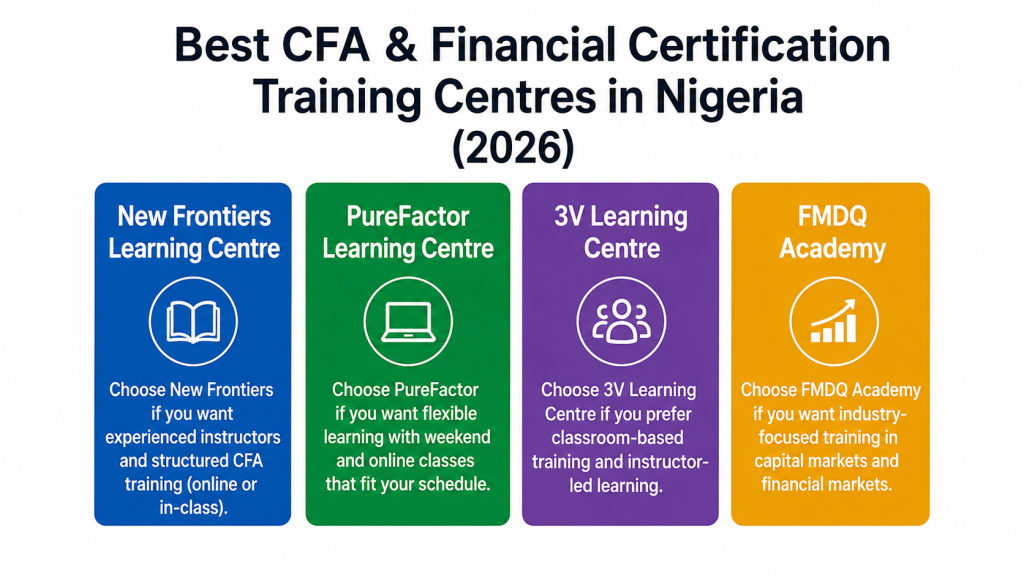
    1. New Frontiers Learning Centre

    Best for: CFA and investment professionals

    New Frontiers is one of Nigeria’s best-known professional learning centres, offering preparation for CFA and other finance-related certifications. Students can choose between classroom sessions and online learning depending on their location.

    Why choose them?

    • Experienced instructors
    • Physical and online classes
    • Structured learning plans
    • Long-standing reputation

    2. PureFactor Learning Centre

    Best for: Candidates who want flexible learning

    PureFactor offers professional certification training with both virtual and in-person learning options. Their programmes are designed for working professionals who need flexibility while preparing for demanding exams.

    Why choose them?

    1. Weekend and online classes
    2. Practical teaching approach
    3. Exam-focused preparation

    3. 3V Learning Centre

    Best for: Classroom-based learning

    3V Learning Centre provides training for a range of professional certifications, including finance and accounting programmes. It is a good option for candidates who prefer face-to-face instruction.

    Why choose them?

    1. Classroom learning
    2. Professional instructors
    3. Multiple certification programmes

    4. FMDQ Academy

    Best for: Capital markets and financial markets professionals

    FMDQ Academy focuses on professional development within Nigeria’s financial markets. While its programmes differ from traditional CFA tuition providers, it offers high-quality executive education for finance professionals looking to deepen their expertise.

    Why choose them?

    • Industry-led training
    • Capital markets expertise
    • Professional development programmes

    Quick Comparison

    Training CentresLearningBest ForIdeal For
    New FrontiersPhysical & OnlineCFA CandidatesStructured classroom learning
    PureFactorPhysical & OnlineWorking professionalsFlexible schedules
    3V Learning CentreMainly ClassroomIn-person learningCandidates who prefer instructor-led classes
    FMDQ AcademyProfessional programmesFinancial market professionalsExecutive and industry-focused learning

    Online or Physical Classes: Which Should You Choose?

    If you’re disciplined and comfortable studying independently, online CFA prep providers can save you money and give you flexibility.

    But if you stay motivated by asking questions, interacting with instructors, and learning alongside others, a physical training centre should be a better fit.

    There’s no right or wrong choice, only the one that works best for you.

    I’ll Leave You With This….

    Choosing a financial certification is a big investment in your career, and picking the right training provider is just as important.

    Before you enrol, take time to compare teaching styles, learning formats, costs, and student support. The best training centre isn’t necessarily the most popular one; it’s the one that gives you the best chance of success.

    Professional certifications can open doors, but they also come with costs. Between tuition, exam registration, and study materials, the investment can feel overwhelming. If finances are the only thing standing between you and your next career milestone, remember that you don’t have to do it alone.

    At Edubanc, we believe your career goals shouldn’t be limited by the cost of learning. Whether you’re preparing for the CFA, FMVA, ACCA, PMP, ICAN, or another professional certification, we’re here to help you access flexible education financing so you can focus on what matters most – passing your exams and building the career you deserve.

    Need help financing your training?

    We’re always happy to guide you through your options.

  • Professional Certifications Is Now A Major Currency for Career Upward Mobility

    Professional Certifications Is Now A Major Currency for Career Upward Mobility

    The modern job market is undergoing a quiet but radical shift. For decades, a university degree was the golden ticket, the ultimate proof that you were qualified, capable, and ready for the corporate ladder.

    But today? A degree is just entry-level table stakes.

    As industries evolve at breakneck speed, traditional academic curriculums are struggling to keep pace. If you want to fast-track your path to leadership, command a premium salary, and insulate yourself from corporate downsizing, you need a different kind of leverage. In the modern economy, professional certifications has become a major currency for career upward mobility.

    Here is why certifications hold the keys to your next promotion, and how you can use them to outpace the competition.

    What Exactly Are Professional Certifications?

    Think of a university degree as a broad, foundational map of a continent. A professional certification, on the other hand, is a GPS dialed into a specific, high-value city.

    Unlike degrees, which focus heavily on theory, professional certifications are structured, specialized credentials awarded by recognized industry bodies (like PMI, Google, or AWS). They verify that you possess targeted, up-to-date, and practical expertise in a highly specific domain. They don’t just prove you studied a subject; they prove you can do the job right now.

    The Real-World Usefulness of Certification

    Investing your time and money into a certificate isn’t about adding letters to your LinkedIn headline. It delivers undeniable, measurable leverage in three distinct ways:

    • Instant Credibility & Trust: When a hiring manager sees a recognized credential on your resume, the baseline filtering is already done for them. A third-party industry authority has essentially vouched for your skills, drastically reducing the perceived risk of hiring or promoting you.
    • A Shield Against AI and Automation: Generalists are easily replaced. Specialists who hold certifications in cutting-edge methodologies or niche technologies possess skills that AI cannot easily replicate, making them indispensable to their organizations.
    • The “Premium Salary” Effect: Data across almost every industry shows that certified professionals earn significantly more than their non-certified peers. Organizations are willing to pay a premium for specialized knowledge because it directly correlates to efficiency and fewer costly mistakes.

    High-Leverage Certifications to Supercharge Your Career

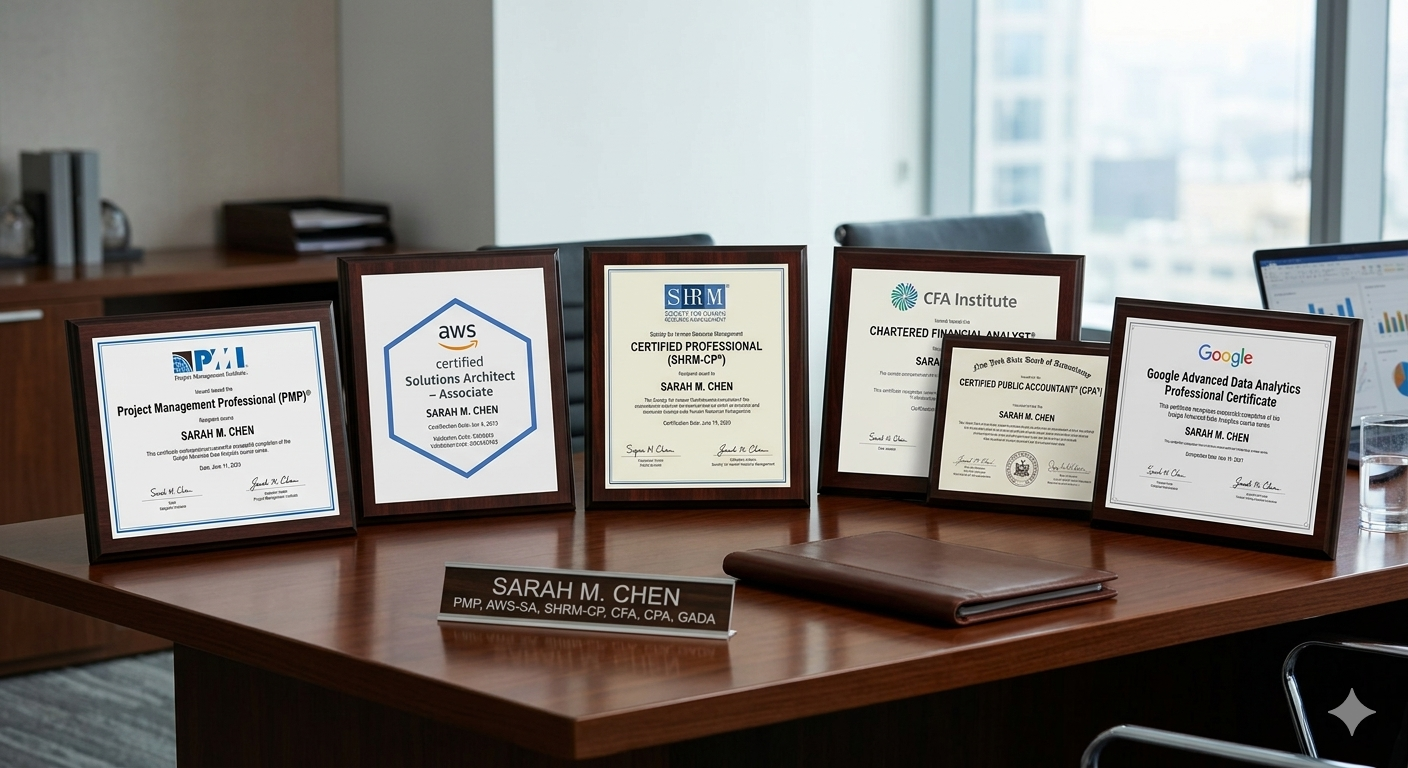
    No matter your specific industry, certain gold-standard certifications act as a force multiplier for your resume. Here are five highly respected credentials across different career tracks that offer massive career leverage:

    CertificationIdeal Career TrackThe Core Benefit
    PMP® (Project Management Professional)Operations, Management, Corporate StrategyUniversally recognized. It proves you can lead cross-functional teams, manage tight budgets, and deliver complex projects on time.
    AWS Certified Solutions ArchitectTech, IT, Software Engineering, Cloud InfrastructureCloud computing runs the modern business world. This certifies your ability to design and deploy secure, robust applications on the world’s leading cloud platform.
    SHRM-CP® (Society for Human Resource Management)HR, Talent Acquisition, People OperationsThe premier standard for HR professionals. It establishes you as an expert in organizational strategy, compliance, and culture-building.
    CFA® / CPA® (Chartered Financial Analyst / Certified Public Accountant)Finance, Accounting, Investment BankingThe ultimate badges of expertise in the financial world. They unlock high-level consulting, auditing, and executive corporate finance roles.
    Google Advanced Data AnalyticsMarketing, Product, Data Science, Business IntelligenceData is the new oil. This certification proves you can clean, analyze, and interpret complex data to drive profitable business decisions. 

    Why Certifications is on of the Major Currency for Upward Mobility

    To understand why certifications are the definitive currency of career growth, we have to look at how modern companies make promotion decisions.

    Upward mobility requires proof of continuous growth. If you rely solely on your daily execution, your manager views you as great at your current job—which often incentivizes them to keep you exactly where you are.

    Professional certifications break this cycle. They are a loud, undeniable signal to leadership that you are actively investing in your own advancement.

    The Skill-Gap Bridge

    When a company prepares to launch a new department or pivot its strategy, they look for people who already bridge the gap. A certification proves you have anticipated the market’s needs. You aren’t asking for a promotion based on “good behavior” or tenure; you are exchanging highly specialized, verified skills for a higher seat at the table.

    In a hyper-competitive corporate landscape, traditional experience moves your career forward in increments. Professional certifications are the Major currency that allows you to skip steps, bypass corporate bureaucracy, and command the upward mobility you deserve.

    For Financing

    CFA or PMP exam, visit Edubanc for support

  • 4 Best CFA Online Prep Courses 2026. Which One Is Worth Your Money?

    4 Best CFA Online Prep Courses 2026. Which One Is Worth Your Money?

    If you’ve decided to write the CFA exam in 2026, congratulations.

    You’ve probably also discovered something very quickly:

    Hoping to pass the CFA level exams is one thing. Choosing the best CFA prep providers is another battle entirely. 

    Oopsies, but yeah. 

    One friend introduces you to a platform. Someone else on Reddit swears by Mark Meldrum. Another says UWorld’s questions feel like the real exam.

    And suddenly, before you even start studying, you’re already confused, overwhelmed, and jittery.

    Here’s the  truth.

    There’s no one best CFA prep provider for everyone.

    It depends on how you learn, how much time you have, and how much you can afford to spend or not spend. 

    What Makes a Good CFA Prep Provider?

    What makes a good CFA prep provider

    Not every CFA exam prep course is built the same. The best CFA study materials should make learning easier, help you practice smarter, and prepare you for exam day.

    Here are a few things to look out for:

    • Strong question bank – for daily practice and concept testing
    • Mock exams – to simulate the real CFA exam experience
    • Video lessons – for easier understanding of difficult topics
    • Study notes & summaries – to simplify the CFA curriculum
    • Study planner – to help you stay on track
    • Affordability – good value for the cost you’re paying

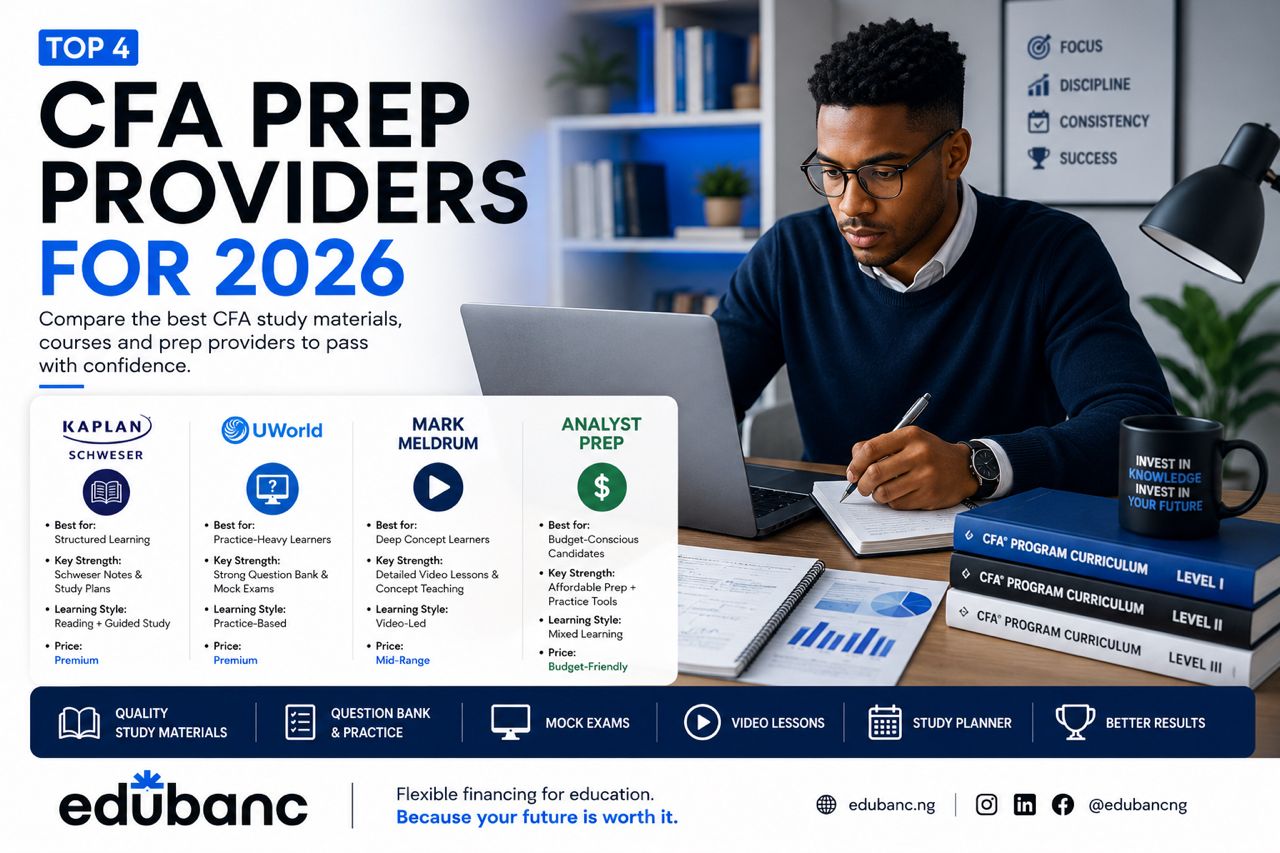
    To save you a headache, I did the homework and found 4 of the top CFA prep providers for 2026, and who they’re best for

    1. KAPLAN Schweser: Best for Structured Learners

    Kaplan is the “safe choice” in the CFA world.

    It’s one of the oldest and most widely used CFA prep providers, known for its famous Schweser Notes, structured study plans, question bank, and mock exams. Many candidates like it because it simplifies the official CFA curriculum into something easier to digest. 

    Best for:

    • First-time CFA candidates
    • People who like structured study plans
    • Busy professionals who want a proven system

    Downsides:

    • More expensive than some alternatives
    • Can feel heavy if you prefer quick learning

    Think of Kaplan as: the “traditional classroom” option

    2. UWorld CFA: Best for Practice Questions & Exam Simulation

    If you learn by doing questions, and not just reading, UWorld is a strong option.

    It’s widely praised for exam-style question banks, deep answer explanations, analytics, and mock exams that many candidates say feel close to the actual CFA exam experience.  

    Best for:

    • Candidates who struggle with practice questions
    • Visual learners
    • People who want strong mock exam prep

    Downsides:

    • Premium pricing
    • May feel “too much” if you just need basic prep

    Think of UWorld as: the “practice until you master it” option

    3. Mark Meldrum: Best for Deep Concept Understanding

    Ask CFA candidates online, and Mark Meldrum’s name comes up a lot.

    He’s especially popular among candidates who want clear video explanations and deeper understanding, not just memorization. His teaching style is straightforward and respected in CFA communities. 

    Best for:

    • Self-directed learners
    • People who like video teaching
    • Candidates who want concept clarity

    Downsides:

    • Less structured than Kaplan
    • Can feel lecture-heavy for some learners

    Think of Mark Meldrum as: the “teach me properly” option

    4. AnalystPrep: Best for Budget-Conscious Candidates

    Not everyone wants to spend a fortune preparing for CFA.

    AnalystPrep has become popular for offering solid question banks, study notes, mock exams, and lower-cost packages compared to premium competitors. It’s often seen as a value-for-money option.

    Best for:

    • Budget-conscious candidates
    • Candidates who want practice + notes
    • People balancing work and study

    Downsides:

    • Not as premium as Kaplan or UWorld
    • Less “brand recognition” than older players

    Think of AnalystPrep as: the “good prep without breaking the bank” option.

    Quick Comparison: Which CFA Prep Course Is Best?

    ProviderBest forPlatform Strength Learning StylePrice Range
    Kaplan SchweserFirst-time CFA candidatesStructured study plans & Schweser NotesReading + guided studyPremium
    UWorld CFAPractice-heavy learnersStrong question bank & exam-style mocksPractice-basedPremium
    Mark MeldrumDeep concept learnersDetailed video lessons & explanationsVideo-ledMid-range
    AnalystPrepBudget-conscious candidatesAffordable prep + solid practice toolsMixed-LearningBudget-friendly

    Comparison of Kaplan Schweser, UWorld, Mark Meldrum and AnalystPrep for CFA exam preparation in 2026

    So… which CFA prep provider should you choose?

    One mistake many CFA candidates make is that they spend thousands registering for the exam, and then struggle to afford good prep materials.

    The right prep provider can save you time, stress, and even failed exam attempts.

    So don’t just ask:

    “Which provider is best?”

    Ask:

    “Which one fits how I learn?”

    That’s usually the better question.

    pay for CFA exam cost, registration and study prep in Nigeria with edubanc.

    Already chosen your prep provider?

    Edubanc can help you spread the cost of CFA exam registration and study materials.